
Why Interoperability Between Workday and ServiceNow Is Critical for Healthcare Compliance
In healthcare, compliance isn’t just about checking regulatory boxes, it’s about ensuring accountability, auditability, and consistent processes across every system that touches patient or workforce data. Yet too often, healthcare organizations treat their Workday (HR, Finance, Supply Chain) and ServiceNow (IT, Risk, and Compliance) environments as separate worlds.
That separation creates blind spots — and blind spots create risk.
Healthcare providers operate under a dense network of regulatory frameworks, including:
HIPAA – for safeguarding patient and workforce health data
CMS Conditions of Participation (CoPs) – for operational and governance oversight
HITECH – for security and breach notification requirements
Joint Commission Standards – for organizational accountability and continuous improvement
SOX (for not-for-profit systems with public reporting) – for financial control integrity
Each of these frameworks depends on accurate, timely, and traceable data, especially data about workforce roles, system access, incident response, and policy adherence. That’s where Workday–ServiceNow interoperability becomes mission-critical.
Why Integration Matters
When Workday and ServiceNow operate in silos, compliance workflows break down:
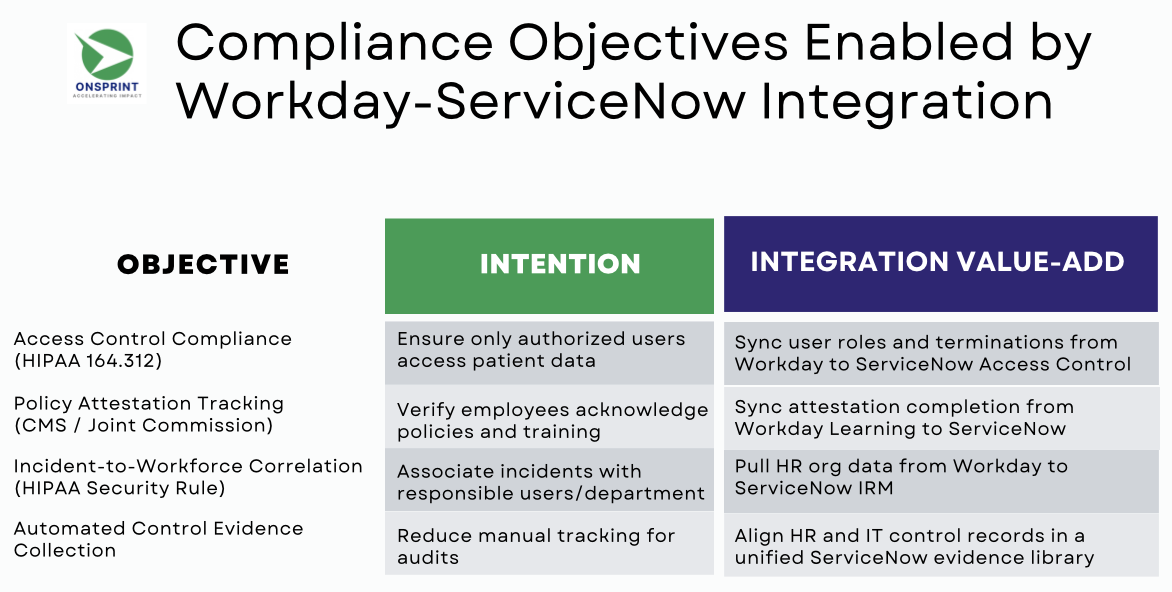
A terminated employee may retain system access because HR updates don’t sync with IT controls.
Policy attestations stored in Workday Learning may not reflect in ServiceNow’s compliance dashboard.
Audit teams waste hours reconciling evidence from both systems.
Integrating the two platforms ensures that people, process, and risk data stay in sync. For example:
When a new clinician is onboarded in Workday, their training, policy attestations, and access reviews can be automatically triggered and tracked in ServiceNow.
When a HIPAA incident is logged in ServiceNow, HR can immediately validate staff assignments and training completion in Workday.
This alignment helps organizations demonstrate continuous compliance, not just reactive evidence during audits.
Contact us for requirements design, user stories and automated project management aligned to these compliance objectives.
